Must Read Books to Get Better Educated
I have often argued that I would non let any teacher into a schoolhouse unless – as a minimum – they had read, carefully and well, the three neat books on education: Plato's Democracy, Rousseau'southward Émile and Dewey'south Democracy and Didactics. There would be no instrumental purpose in this, but the struggle to understand these books and the thinking involved in agreement them would change teachers and ultimately instruction.
These are the 3 cracking books because each is sociologically whole. They each nowadays a description and arguments for an teaching for a item and better social club. You do not have to agree with these authors. Plato'south tripartite education for a just society ruled over past philosopher kings; Rousseau's education through nature to establish the social contract and Dewey'due south relevant, problem-solving democratic education for a democratic society tin all be criticised. That is not the point. The indicate is to understand these great works. They constitute the intellectual background to any informed discussion of education.
What of more modernistic works? I used to recommend the "blistering indictment" of the flight from traditional liberal education that is Melanie Phillips's All Must Have Prizes, to be read alongside Tom Bentley'south Learning Beyond the Classroom: Teaching for a Changing World, which is a defence of a wider view of learning for the "learning age". These ii books divers the debate in the 1990s between traditional didactics by authoritative teachers and its rejection in favour of a new learning in partnership with students.
Much fourth dimension and coin is spent on instructor training and continuing professional development and much of information technology is wasted. A cheaper and better way of giving student teachers and in-service teachers an understanding of education would be to become them to read the 50 great works on pedagogy.
The books I take identified, with the help of members of the Institute of Ideas' Education Forum, teachers and colleagues at several universities, constitute an attempt at an educational activity "canon".
What are "out" of my list are textbooks and guides to classroom practice. What are also "out" are novels and plays. Simply in that location are some smashing literary works that should be read past every teacher: Charles Dicken'south Hard Times – for Gradgrind's at present much-needed commemoration of facts; D. H. Lawrence's The Rainbow – for Ursula Brangwen's struggle against her early on child-centred idealism in the reality of St Philips School; and Alan Bennett's The History Boys – for Hector's role every bit the destructive instructor committed to knowledge.
I hope I take produced a list of books, displayed hither in alphabetical society, that are held to be of import past today's teachers. I make no apology for including the volume I wrote with Kathryn Ecclestone, The Dangerous Ascent of Therapeutic Education because it is an influential disquisitional piece of work that has produced considerable controversy. If you disagree with this, or any other of my choices, please add your culling "canonical" books on education.
Michael W. Apple – Official Knowledge: Autonomous Education in a Conservative Historic period (1993)
Hannah Arendt – Between Past and Future (1961), for the essay "The Crisis in Education" (1958)
Matthew Arnold – Culture and Anarchy (1867-ix)
Robin Barrow – Giving Teaching Back to the Teachers (1984)
Tom Bentley – Learning Beyond The Classroom: Pedagogy for a Changing World (1998)
Allan Flower – The Closing of the American Mind: How Higher Education Has Failed Democracy and Impoverished the Souls of Today's Students (1987)
Pierre Bourdieu and Jean-Claude Passeron – Reproduction in Pedagogy, Society and Civilization (1977)
Samuel Bowles and Herbert Gintis – Schooling in Capitalist America: Educational Reform and the Contradictions of Economical Life (1976)
Jerome Bruner – The Process of Education (1960)
John Dewey – Democracy and Pedagogy (1916)
Margaret Donaldson – Children's Minds (1978)
JWB Douglas – The Dwelling and the School (1964)
Kathryn Ecclestone and Dennis Hayes – The Unsafe Rise of Therapeutic Education (2008)
Harold Entwistle – Antonio Gramsci: Conservative Schooling for Radical Politics (1979).
Paulo Freire – Pedagogy of the Oppressed (1968/1970)
Frank Furedi – Wasted: Why Educational activity Isn't Educating (2009)
Helene Guldberg – Reclaiming Childhood (2009)
ED Hirsch Jnr. – The Schools We Need And Why We Don't Have Them (1999)
Paul H Hirst – Knowledge and the Curriculum(1974) For the essay which appears as Chapter 3 'Liberal Education and the Nature of Knowledge' (1965)
John Holt – How Children Fail (1964)
Eric Hoyle – The Office of the Teacher (1969)
James Davison Hunter – The Death of Grapheme: Moral Education in an Age without Practiced or Evil (2000)
Ivan Illich – Deschooling Society (1971)
Nell Keddie (Ed.) – Tinker, Taylor: The Myth of Cultural Deprivation (1973)
John Locke – Some Thoughts Concerning Instruction (1692)
John Stuart Mill – Autobiography (1873)
Sybil Marshall – An Experiment in Teaching (1963)
Alexander Sutherland Neil – Summerhill: A Radical Arroyo to Child Rearing (1960)
John Henry Newman – The Idea of a University (1873)
Michael Oakeshott – The Voice of Liberal Learning (1989) In item for the essay "Pedagogy: The Appointment and Its Frustration" (1972)
Anthony O' Hear – Didactics, Social club and Homo Nature: An Introduction to the Philosophy of Education (1981)
Richard Stanley Peters – Ethics and Didactics (1966)
Melanie Phillips – All Must Accept Prizes (1996)
Plato – The Republic (366BC?)
Plato – Protagoras(390BC?) and Meno (387BC?)
Neil Postman – The Finish of Education: Redefining the Value of Schoolhouse (1995)
Neil Postman and Charles Weingartner – Education every bit a Subversive Activity (1969)
Herbert Read – Education Through Art(1943)
Carl Rogers – Liberty to Learn: A View of What Education Might Become (1969)
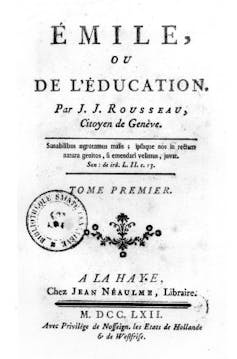
Jean-Jacques Rousseau – Émile or "on education" (1762)
Bertrand Russell – On Didactics(1926)
Israel Scheffler – The Language of Instruction (1960)
Brian Simon – Does Education Affair? (1985) Particularly for the paper "Why No Pedagogy in England?" (1981)
JW Tibble (Ed.) – The Written report of Pedagogy (1966)
Lev Vygotsky – Thought and Language (1934/1962)
Alfred North Whitehead – The Aims of Education and other essays (1929)
Paul E. Willis – Learning to Labour: How Working Class Kids Get Working Course Jobs (1977)
Alison Wolf – Does Educational activity Matter? Myths almost Education and Economic Growth (2002)
Michael FD Young (Ed) – Noesis and Control: New Directions for the Sociology of Education (1971)
Michael FD Immature – Bringing Cognition Back In: From Social Constructivism to Social Realism in the Sociology of Education (2007)
Source: https://theconversation.com/the-50-great-books-on-education-24934
0 Response to "Must Read Books to Get Better Educated"
Post a Comment