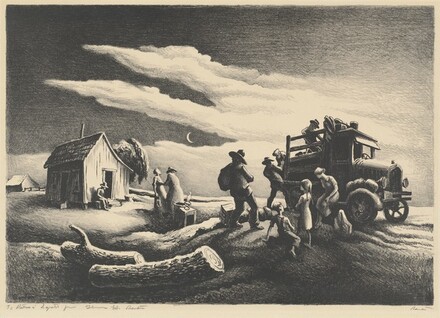
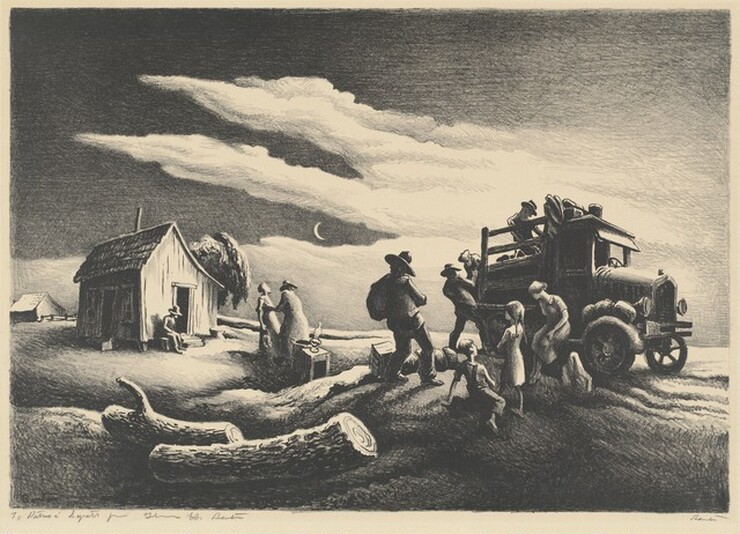
Thomas Hart Benton, Twentieth-Century Fox Flick Corporation, Departure of the Joads, 1939, lithograph in black on wove paper, Reba and Dave Williams Collection, Florian Carr Fund and Souvenir of the Print Research Foundation, 2008.115.14
Does art "piece of work" or have a purpose? How?
Is making art a grade of work? Make your argument for why or why not.
Franklin Delano Roosevelt stated that fine art in America has never been the sole province of a select group or class of people. Do you concur or disagree?
Define what yous call back Roosevelt meant by "the autonomous spirit." How do yous think art can stand for democratic values?
The Great Low spanned the years 1929 to about 1939, a menses of economical crunch in the U.s.a. and around the world. High stock prices out of sync with production and consumer demand for goods caused a marketplace chimera that burst on October 24, 1929, the famous "Black Th" stock market crash. The severity of the market place contraction affected Americans across the land. The near visible effects included widespread unemployment, homelessness, and a marked decrease in Americans' standard of living. In add-on, a severe drought produced the Grit Bowl—a series of damaging dust storms. This environmental disaster ruined many farmers during a period when the economy was largely agricultural.
In office at the time of the crash, President Herbert Hoover (term 1929–1933) was unable to cease the gratis fall of the American economy. His successor, Franklin Delano Roosevelt, was elected president in a landslide in 1933 with entrada promises to gear up the economic system. Roosevelt acted quickly to create jobs and stimulate the economy through the cosmos of what he called "a New Bargain for the forgotten man"—a program for people without resources to back up themselves or their families. The New Deal was formalized every bit the federal Works Progress Administration (WPA), an umbrella agency for the many programs created to help Americans during the Depression, including infrastructure projects, jobs programs, and social services.
Through the WPA, artists too participated in authorities employment programs in every state and county in the nation. In 1935, Roosevelt created the Federal Art Project (FAP) every bit the agency that would administer creative person employment projects, federal art commissions, and community art centers. Roosevelt saw the arts and access to them as fundamental to American life and democracy. He believed the arts fostered resilience and pride in American culture and history. The art created under the WPA offers a unique snapshot of the country, its people, and art practices of the flow. There were no regime-mandated requirements about the subject of the art or its style. The expectation was that the art would relate to the times, reflect the place in which information technology was created, and be attainable to a wide public.
Artists working in the FAP and for other WPA agencies created prints, easel paintings, drawings, and photographs. Public murals were painted for brandish in post offices, schools, airports, housing developments, and other authorities buildings. Community art centers hosted exhibitions of work fabricated by artists employed in government programs and offered hands-on workshops, led past artists, for everyone. Illustrators made detailed drawings that cataloged the physical culture and artifacts of American daily life—clothing, tools, household items. The WPA intentionally seeded arts programs and supported artists outside of urban centers. In so doing, it introduced the arts to a much more diverse swath of Americans, many of whom had previously never seen an original painting or work of fine art, had non met a professional person artist, nor experimented with art making.

Swell Depression Walker Evans,The Breadline, 1933, gelatin silver print, Gift of Katherine Fifty. Meier and Edward J. Lenkin, 1991.173.ane
This image is of a breadline in Cuba, showing united states of america the event of the Great Low on other nations. People line upward confronting a fence, where a sign reads: "Cocina gratuita de Periodico, Departo de Raciones" (Temporary Gratuitous Kitchen, Ration Distribution).
Walker Evans went to Republic of cuba in 1933, but not to document the effects of the Depression. He was on assignment to take photographs for a book entitled The Crime of Cuba. The book was a critique of the regime of President Gerardo Machado y Morales, in part from 1925 to 1933. Equally the Depression was felt in Cuba, Machado'due south regime became increasingly repressive, which fostered civil unrest. He was overthrown with assistance from the U.s.a. before long after The Crime of Cuba was published. Machado was succeeded by Fulgencio Batista who was, in turn, overthrown by Fidel Castro in 1956.
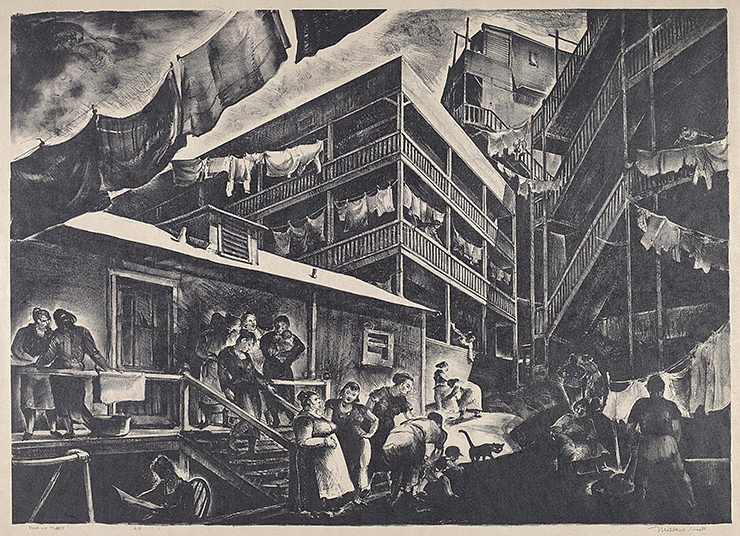
Great Depression Millard Sheets,Family Flats, 1935, lithograph in black on heavy Japanese paper, Reba and Dave Williams Collection, Gift of Reba and Dave Williams, 2008.115.4385
"Family flats" were houses and buildings divided by a landlord into small apartments, often overcrowded and in poor condition, and were also known as tenements. Such housing was frequently the only option for poor families. The place shown hither is Millard Sheets'southward native Los Angeles, in a neighborhood that no longer exists called Bunker Hill. You tin get a sense of the pitched topography as the buildings at the height of the image rise quite high above the figures at the very bottom of the frame. It is laundry day and groups of women conversation, do their wash using buckets (at right), and hang clothes on the swinging lines that crisscross the picture. Effort to count the number of clotheslines and and so the number of other diagonal forms. Name each blazon of diagonal you see (east.g., roofline, railing, stair). How exercise the diagonals create a sense of activity and motion? Imagine if the lines were all perpendicular or parallel. How would the scene be unlike? Try to draw a sketch of the scene replacing the diagonals with perpendicular or parallel lines. Run across the Pinterest lath for a painting of this same scene that Sheets painted in 1934, upon which he based this print.

Great Depression Seymour Fogel,Untitled (Pensive Blackness Man), 1936, lithograph, Reba and Dave Williams Collection, Gift of Reba and Dave Williams, 2008.115.1807
This empathic and realistic portrait of a man encumbered past hard times is a compelling ane. The give-and-take "attack" can be fabricated out on the newspaper on the man'due south lap. Notation that the word is written backward. This is because the work is a print, the orientation of which is reversed when the paper is applied to the lithographic rock. What attack might the newspaper be announcing given the human being's attitude and the engagement of the epitome? How did events of the 24-hour interval both negatively and positively bear upon life for ordinary Americans?
The artist, Seymour Fogel, worked as an apprentice to Mexican muralist Diego Rivera in New York. Rivera's art was in loftier demand during the 1930s and he traveled the United States completing mural commissions. Fogel went on to paint approximately 20 of his ain public murals for the Works Progress Administration'due south Federal Fine art Project and with the Department of the Treasury. Run across the resources section of this module to assist you lot locate WPA-era murals and public works in your own community.

Great Depression Seymour Fogel,New York No. i, 1936, lithograph, Reba and Dave Williams Collection, Gift of Reba and Dave Williams, 2008.115.1805
While one man works, sawing wood at the center of the epitome, others sit down on the basis effectually him, dozing or reading a newspaper perchance. The time may be night, with illumination coming from streetlights beyond where the men are gathered. A poster with an attracting female figure is featured, mayhap advertising a caricatural bear witness, and suggesting moral temptations to men not gainfully occupied. Although the setting is ambiguous, the human being may exist sawing wood to create a shanty or shelter of some sort, as the slanted panels simply behind him suggest. During the Depression, people made homeless by the crisis frequently congenital such improvised structures. Groupings of such dwellings were dubbed "Hoovervilles" in critique of President Herbert Hoover (in office from 1929 to 1933), who was unable to enact programs to effectively help people plunged into poverty by the Depression. What parts of the scene tell you that this group of people may take fallen on hard times? Delight encounter the Pinterest board for additional related images.
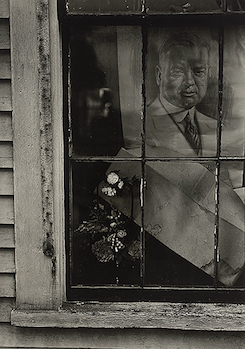
Great Low Walker Evans,Political Poster, Massachusetts Village, 1929, gelatin silver print, Corcoran Collection (Gift of Murray H. Bring), 2015.xix.4232
Walker Evans had a keen heart for the telling detail. He photographed this weathered window featuring a poster for presidential candidate Herbert Hoover. Hoover ran for and won the presidency in 1928, elected on the strength of his successful piece of work to alleviate hunger in Europe after Earth State of war I. If y'all look closely, you can make out the "-er" of "Hoover" on the poster, which is no longer proudly displayed, simply rather folded like origami and stained at the bottom. Its state seems to presage President Hoover'south sinking reputation once the Depression was underway, although Evans could not have known this in 1929. A small, faded bloom organisation on the sill reinforces the impression of a loss of hope and time moving on.
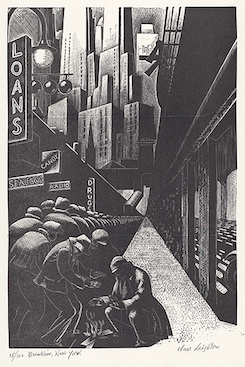
Great Depression Clare Leighton,Breadline, New York, 1932, wood engraving in black on wove paper, Reba and Dave Williams Collection, Gift of Reba and Dave Williams, 2008.115.3119
Compare this image of a Depression-era breadline to Walker Evans'southward The Breadline, 1933. Expect at specific parts of the scene: How are the people in the breadline portrayed? What is the setting? The season? Support your responses with specific show from the pictures. Think about differences in medium (forest engraving versus photography), in composition (arrangement of shapes and forms), and style (realistic or stylized). Take note of specific features such as facial expressions, words included in the image, etc.
The artist Clare Leighton was built-in in England and afterwards became an American denizen. She was a specialist in a distinct type of woodblock printing called wood engraving, which allows the artist to create very fine lines and details. Typically, woodblock printing is characterized by rougher, more than expressive lines (see the Pinterest board for an instance, Fred Becker's Rapid Transit, c. 1937). Wood engravers usually cut their designs into a very hard wood similar boxwood. Typically, they emphasize the utilize of white, or "negative" line, to create an prototype, rather than black line (as in drawing). You can go a sense of what this approach is like by drawing on a black scratchboard with a white underlay.
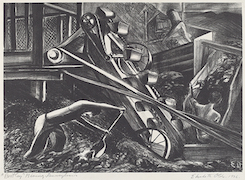
Great Depression Elizabeth Olds,Bootleg Mining, Pennsylvania, 1936, lithograph, Reba and Dave Williams Collection, Gift of Reba and Dave Williams, 2008.115.3787
Afterward a solar day's work, coal miners in Pennsylvania and elsewhere would frequently "glean" coal for personal use—with the tacit permission of mine managers. However, worker layoffs during the Depression due to decreased demand for coal and the automation of coal mining led to a huge increase in bootleg—or illegal—mining practices. Laid-off workers returned to mines without permission to dig or collect coal on their own then sold the bootlegged coal on the open up market. The economy of bootlegged coal became big business, with estimates of upwards to 100,000 people in Pennsylvania living off the exercise. Oral history records ane miner stating, "Nosotros 'steal' coal in lodge to keep from condign thieves and concord-upward men, which, to go on alive, we probably would be forced to get if we didn't have these holes" (Louis Adamic, "The Cracking Bootleg Coal Industry," originally published in The Nation, 1934).
Elizabeth Olds vividly illustrates the situation: the hulking machinery despised past the miners sits idle, while men work with a shovel, pickax, and crate to dig the coal manually.

Corking Depression Walker Evans,Abandoned Ante-Bellum Plantation House, Vicksburg, Mississippi, 1936, gelatin silver impress, Robert B. Menschel Fund, 1989.69.11
Walker Evans worked for an agency of the Works Progress Administration, the Farm Security Administration, from 1935 to 1937. He traveled across the rural South to photograph the effects of the Depression. This house, with its classical columns and imposing form, was once thousand. Yet ultimately, it was subject to the same destructive economical and ecology forces that devastated plantations and farms small and large throughout the U.s.. It also appears to symbolize the final demise of a manner of life built on the labor of enslaved people.
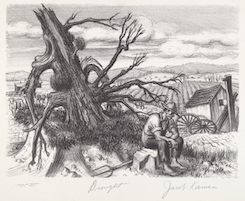
Dandy Depression Jacob Kainen, Federal Art Project (New York City),Drought, 1935, lithograph, Reba and Dave Williams Collection, Souvenir of Reba and Dave Williams, 2008.115.2754
Many artists created images that addressed the environmental devastation that occurred during the Depression. The furnishings of the bad economy were magnified for agronomical workers and American Indians living on reservations, whose Native lands were overgrazed by livestock permitted there by federal rules, and vulnerable to erosion. In Jacob Kainen'southward work, what signs practice you see in the moving-picture show that offer clues to the state of the surround? You lot may detect the farmer'southward downcast appearance likewise as the twisted, dead tree, sandy-looking soil, bony livestock, and sparse vegetation in the fields. Discarded railroad vehicle wheels may bespeak in that location is nothing to harvest or transport.
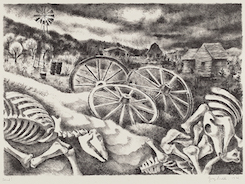
Great Depression George Biddle,Sand!, 1936, lithograph, Reba and Dave Williams Drove, Gift of Reba and Dave Williams, 2008.115.903
The imagery in Biddle'sSand!and Kainen'sDroughtis similar; notice the placement of the horizon line, gathering storm or grit clouds, and the apply of the wagon wheel motif, which may symbolize the halt of progress and inability to motility on from difficulties. Biddle's work offers more than explicit imagery—suggesting the basic of domestic livestock that withered from starvation. Biddle studied the fine art of Mexican muralists who frequently used decease imagery andSand!may reflect their influence. Biddle was also instrumental in advising Franklin Delano Roosevelt to kickoff a plan paying unemployed artists a living wage to create images reflecting aspects of American life, which eventually became the Federal Art Program.
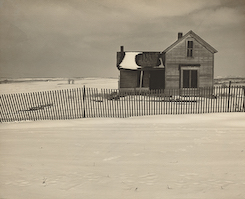
Great Low Wright Morris,Nebraska Farm Business firm, 1940, gelatin silver impress, Robert B. Menschel Fund, 1997.32.1
This business firm is not located on the seashore, simply in the eye of Nebraska. Photographers working for the Farm Security Administration (FSA) took images such as this one to both document and publicize the plight of farmers in the news media—newspapers and magazines at that time—and assistance the public understand the effects of the drought, the Depression, and resettlement programs. They too sought to influence policy and budget decisions in Washington, DC. Many of their photographs are at present in museums, but they were non considered art at the time of their making. Today, the 80,000 images taken by FSA photographers form an important archive about the Low years and the extreme environmental conditions that occurred due to poor agricultural practices, producing erosion, combined with a persistent lack of rainfall.

Peachy Depression Thomas Hart Benton, Twentieth-Century Fob Pic Corporation,Departure of the Joads, 1939, lithograph in black on wove paper, Reba and Dave Williams Drove, Florian Carr Fund and Souvenir of the Print Research Foundation, 2008.115.14
John Steinbeck'due south 1939 novel, The Grapes of Wrath, was inspired past the real-life tribulations that the writer observed in his native California. In the novel, the Joad family unit abandons their Oklahoma farm due to drought and seeks a new life in California. Here, the Joads pack their truck as they set up to depart. The novel relates that the time is just before dawn, with the moon rising in the west and a table with a lantern on it. In Benton'south lithograph, two ominous fingers of clouds reach across from right to left, maybe threatening a stinging dust storm.
Difference of the Joads was part of a serial of six prints that were created past Thomas Hart Benton every bit promotional material for the 1940 film based on the book. The images were blown up to billboard size to advertise the motion picture.

Great Low Dorothea Lange,Subcontract Security Assistants campsite for migrant agricultural workers at Shafter, California, June 1938, gelatin silver print, Corcoran Drove (Gift of Joshua P. Smith), 2015.19.4298
Families from Oklahoma, Arkansas, Missouri, and Texas abandoned their drought-stricken farms to seek jobs as migrant farmworkers in California. Workers were lucky to find a place in a clean and organized agronomical migrant camp such as this one in California's Central Valley, one of the first constructed to run into the basic needs of recent arrivals. Other migrants were not then fortunate and formed ad hoc camps near irrigation ditches or roadways, where health and sanitation problems frequently arose. The number of arriving people vastly outnumbered the bachelor jobs or places to live.
Dorothea Lange worked as a portrait photographer in San Francisco for a decade before pursuing her interest in documenting social justice issues, commencement with the California Land Emergency Relief Assistants and so with the Federal Resettlement Bureau, which became the Farm Security Administration. Many of her photographs came to vividly symbolize the economic and social problems of her time.
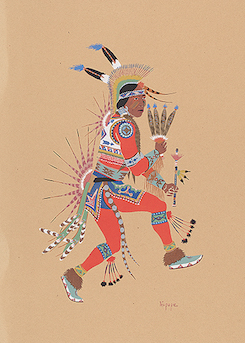
Great Depression Stephen Mopope,#17 (Red Dancer), c. 1940s, pochoir, Reba and Dave Williams Collection, Souvenir of the Impress Research Foundation, 2008.115.450
Stephen Mopope (Kiowa Tribe) depicted ceremonial dance and other aspects of the Plains Indians' culture. Mopope's artistic talent was recognized early on the Oklahoma reservation where he grew up. He trained in techniques of painting on hides used for garments and tipis (his traditional Kiowa name was Qued Koi, which ways "Painted Robe") and as well was a adept dancer and musician. Mopope and 4 other artists, who later became known as the Kiowa Five, attended the University of Oklahoma School of Art during the late 1920s, among the first Native Americans to do and then. The Five participated in exhibitions in the Us and away and later on created a portfolio of prints produced in Paris, of which #17 (Red Dancer) and the side by side image,#nineteen (Three Dancers), are a part.
The works were made with a print-making technique known every bitpochoir, or hand-colored stenciling. Stencils are created by cutting out a design from a rigid material such every bit paper-thin, placing it over another surface, and applying color over the cut areas to produce an prototype. A stencil permits the production of multiple images, which vary with the materials or colors used each time. Endeavor making your own pochoir and echo the process with different colors or on different types of surfaces.

Corking Depression Stephen Mopope,#19 (3 Dancers), c. 1940s, pochoir, Reba and Dave Williams Collection, Souvenir of the Print Research Foundation, 2008.115.449
Kiowa Native American art often depicts the ceremonial dances, events, and symbolizes the beliefs that reflected the culture. Stephen Mopope, a Kiowa artist, dancer, and musician, grew upward on a reservation in the Southwest U.S. where he was trained in the arts by his uncles who were also prominent Kiowa artists. Afterward, at the Academy of Oklahoma School of Art, he blended the traditional art skills he had learned with European training, including painting on media such as paper, sail, and in a mural format.
The technique that Mopope used to create the ii works represented in this prepare is known equallypochoir, or hand-colored stenciling, a printmaking method. Although stenciling is centuries old and practiced in numerous cultures, the termpochoirwas get-go popularized in France in the 1920s in graphic arts and illustration. Mopope and the Kiowa grouping developed what became known every bit the apartment style, in evidence here, which relates to the techniques used to paint on hides (used for ceremonial robes and tipis) to brand the imagery graphically legible.
Mopope'southward feel translated well to the public art murals he painted for Andarko, Oklahoma Post Office on Kiowa country under the Federal Art Program and for the Department of the Interior building in Washington, DC (where they may be seen today). Recollect virtually how public art murals painted on a wall might be different from a portable painting on sail – what factors might an creative person take into business relationship?
Run into the related Pinterest board for imagery of the Washington, DC, murals.

Nifty Depression Leon Bibel,Red Hot Franks, 1938, screenprint, Reba and Dave Williams Drove, Gift of Reba and Dave Williams, 2008.115.888
Artists during the Low portrayed what they saw effectually them in different means, not all of them realistic. Influences such as the urban landscape, music, and the work of other artists, similar that of the cubists, also shaped how they saw the earth around them. Artists strived to depict not only sights, just sounds, feelings, and experiences of life as it was lived.
The subject of Leon Bibel'due south screenprint depicts what may take been an everyday sight on New York Urban center streets: a pushcart vendor selling food, in this case franks and lemonade. How is this commonplace scene portrayed differently from a realistic rendering? Consider: the buildings tilting at dissimilar angles, the flat areas of color, the wavelike swoop of the curb, the cart'due south umbrella split in two by a building, and how the colors of the vendor and the scene are the same, as if he himself is a feature of this landscape.

Great Low Stuart Davis,Sixth Avenue El, 1931, lithograph in blackness on wove paper, Reba and Dave Williams Collection, Florian Carr Fund and Gift of the Impress Research Foundation, 2008.115.52
Stuart Davis worked in New York Metropolis, whose skyline was growing and changing, adding high-rises, bridges, and transit lines, into which people were funneled and came into proximity with one another in new, impersonal ways. If you've ridden a charabanc, subway, or elevator, you lot have had such an experience.
Stuart Davis'southward lithograph is inspired by the "el" or elevated train line (many in New York Metropolis were dismantled to make mode for current 24-hour interval subway lines). Describe what you lot see in the paradigm: What do you recognize and what seems unfamiliar? How might this image relate to the experience of riding the elevated train, or walking near it as it zoomed by overhead?
On the Pinterest lath, you can see a photograph past Berenice Abbott,Jefferson Market Court, 1935, that shows a view of the El that may accept inspired Stuart.

Dandy Depression Grant Wood,New Road, 1939, oil on canvass on paperboard mounted on hardboard, Gift of Mr. and Mrs. Irwin Strasburger, 1982.seven.2
Grant Wood, who was built-in and lived most of his life in Iowa, worked as an artist with the Works Progress Administration's Public Works of Fine art Project (PWAP, a predecessor of the Federal Art Projection). He created murals, notably for Iowa State University'south library, that pictured the virtues of rural life. Wood also served as the director of PWAP in Iowa, coordinating public art projects across the state. Please run across the Pinterest lath for images of the Iowa State mural that Wood completed.
Wood's pictures of rolling and verdant farmlands, which have an idealized, dreamlike quality, depart from the images of drought and subcontract devastation that many WPA-era artists created. By 1939, the Dust Bowl and drought had subsided (information technology lasted from most 1931 to 1937) and the economic system was benefiting from WPA investment in restoring agricultural land and jobs in public works, as well as the offset of World War II production. How might this image symbolize new hope in America?

Great Depression Berenice Abbott,Automat, 977 Eighth Avenue, Manhattan, 1936, gelatin silver print, Gift of the Collectors Committee, 1996.6.1
Automats were an early kind of self-service eatery that offered cheap food to eat in a cafeteria or to take away. Patrons inserted coins next to a window containing their choice of food, and the door unlocked, permitting them to remove it. Automats were the first fast-food restaurants and they opened in urban environments where a lot of people needed to discover food chop-chop and cheaply. The popularity of automats peaked during the Great Low.
In 1935, Berenice Abbott proposed and directed a project for the WPA'due south Federal Art Project chosen "Changing New York." Her appetite was to photo-document New York City, which was apace modernizing with skyscrapers; new, often WPA-funded infrastructure such as subway lines, bridges, and tunnels; and novel types of shops and conveniences, such as this automat. Abbott too documented aspects of old New York that were being razed to make way for the new. Her work was published in a volume of the aforementioned name, which was distributed to New York City high schools, libraries, and public institutions.

Great Depression Bernarda Bryson,Arkansas Sharecroppers, 1935–1936, lithograph, Reba and Dave Williams Collection, Souvenir of Reba and Dave Williams, 2008.115.4357
This impress by Bernarda Bryson and the following photograph by Gordon Parks are each inspired by Grant Wood's famous painting,American Gothic,1930.American Gothicportrays an ascetic and prim farmer couple outside their clapboard house (which features a pointed "Gothic" window). You lot tin can see an image of Wood's painting on the related Pinterest board (and a dissimilar work by Forest elsewhere in this slideshow).
The couple in Bryson's lithograph stand up in a similar frontal pose, simply their appearance, and that of their home, is shabby and rickety in contrast to Wood's painting. Signage behind them on some outbuildings refers to "malaria, chills, and fever" forth with repeated use of "666." Bryson was the companion of another artist who participated in WPA programs, Ben Shahn. They worked together to document aspects of a disappearing rural America.

Great Depression Gordon Parks,Washington, D.C. Authorities Charwoman (American Gothic), July 1942, gelatin silverish print, printed later on, Corcoran Collection (The Gordon Parks Collection), 2016.117.104
Gordon Parks, a photographer, musician, and filmmaker, created this iconic paradigm that besides makes reference to Grant Wood's painting,American Gothic, 1930. While he lived in Washington, DC, working for WPA programs, Parks created a series of photographs about the life of Ella Watson. Watson was an ordinary woman who worked in housekeeping for the federal government (in the offices that housed the Farm Security Administration) in Washington, DC, to support her family. Parks photographed Watson's life, both at piece of work and at home, extensively. Here, she lone assumes the frontal pose of Wood'due south painting, missing a partner, with a mop or broom in place of a pitchfork.
The work of Bernarda Bryson (previous slide) and Parks poses questions about the hope of and disappointments in pursuit of the American dream, and to whom information technology is available.
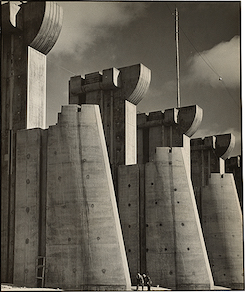
Great Depression Margaret Bourke-White,Fort Peck Dam, Montana, 1936, gelatin argent print, Patrons' Permanent Fund, 2014.113.1
Margaret Bourke-White'south photograph of the Fort Peck Dam nether construction was famous—it graced the embrace of the starting time result of Life magazine in 1936. (Run across the related Pinterest board for a flick of the mag encompass.) The hulking bandage concrete piers, supports for an elevated roadway over the dam'south spillway, almost look similar abstruse sculptures. Bourke-White maximized their visual drama by including figures at the lesser to show the calibration of the piers and the dynamic diagonal line in which they are arrayed, as if marching forward. The photograph captures the fascination with the dramatic new structures of modern life.

Great Low James E. Allen,Arch of Steel, 1937, lithograph in black, Reba and Dave Williams Collection, Souvenir of Reba and Dave Williams, 2008.115.644
The Bayonne Span is pictured here under structure as a pre-WPA project. (It was completed in 1931.) The span connects Bayonne, New Jersey, with Staten Island, New York City; below, ships pass back and forth, to and from the Port of Newark. Post-obit its construction, numerous bridges and other elements of infrastructure were funded and built through WPA programs and continue to serve as public civilities today. WPA artists documented and made art inspired by the urban mural to create positive images of progress in American order and the economy. Bayonne Bridge continues to exist in service today and in 2017 it was lifted by 64 anxiety in order to accommodate larger ships passing underneath. Delight come across the related Pinterest board for an image of how the bridge looks today.

Great Depression Gifford Beal, Gathering Brush, Primal Park, 1934, drypoint in black on laid newspaper, Corcoran Collection (Museum Purchase, Mary East. Maxwell Fund), 2015.19.376
From 1934 to 1938, the Works Progress Assistants assigned workers to make improvements to New York'south Central Park, which included clearing dead trees; building new paths and walls; seeding and reviving the landscaping; and placing amenities like benches, trash cans, lighting, and drinking fountains throughout the park, many of which are still in use today. Artists also working for the WPA documented and created images of the projects and improvements being made to public spaces.

Great Depression Henry Tomaszewski,Carousel Giraffe, c. 1939, watercolor and graphite on paperboard, Alphabetize of American Blueprint, 1943.eight.17121
This drawing is one of thousands that artists employed by the Federal Art Project made for the Alphabetize of American Design (IAD). The IAD compiled detailed drawings of the well-crafted, everyday objects that represented American material culture from colonial times to about 1890. Objects illustrated included examples of folk fine art, decorative arts (furniture, rugs, ceramics, quilts, etc.), article of clothing, signs, and household objects—such every bit weather condition vanes, piggy banks, tools, puppets, and this merry-become-circular giraffe. Each artist drew from the actual object, whose dimensions were often recorded alongside information about the drawing itself.
The IAD sought to establish a record and history of American design that reflected the country's unique history, origins, and diverse people and places. Information technology showcased the ingenuity, pragmatism, and pride craftspeople took in their piece of work, and sought to foster people's pride in those accomplishments.

Smashing Depression Orville A. Carroll,Bonnet, 1935/1942, watercolor, graphite, and gouache on paperboard, Alphabetize of American Design, 1943.eight.16810
Drawings made for the Index of American Design project during the Depression offering a valuable record of not only arts and crafts, simply the handmade ordinary objects used in everyday life–a washboard, jug, railroad vehicle, toy, saddle, or hammer—from colonial times until about 1890. By the 1930s, the pace of modernization, with its increasing reliance on mass-produced bolt, prompted IAD programme administrators to seek to document an earlier way of life in which American craftspeople produced past hand all the things needed for living, one past one. The IAD also generated needed jobs for artists, administrators, and researchers. Finely crafted objects, such as this delicate Shaker-style woven and fabric hat and utilitarian, functional items like an ox-cart expressed the range of American design.
This drawing represents an example among the nearly 22,000 that were produced by a squad of 400 artists working in 36 states. The planned book—to be distributed to public schools and libraries around the country—was never published as its funding was appropriated for the World War Two attempt. However, exhibitions of the completed drawings were shown in section stores, community arts centers, and museums around the country. The National Gallery of Art is the largest repository of these drawings, many of which can exist viewed online.

Great Depression Lucienne Bloch,Land of Plenty, 1936, woodcut in black on wove paper, Reba and Dave Williams Collection, Gift of Reba and Dave Williams, 2008.115.944
This family of four, who announced tired and bent over, with ragged clothing and bare feet, pass before a field of abundant corn and soaring electric lines overhead. The motion picture on one mitt represents hope and recovery from the Depression—electricity was made available to many more than Americans as office of WPA infrastructure projects, and the Farm Security Administration of the menses provided help to farmers. Yet, a fence separates the family from these resources, which are inaccessible to them. The image may comment on the lack of equity in the distribution of such life-sustaining resources to families of colour. Lucienne Bloch studied with and was an banana to Mexican muralist Diego Rivera, working with him on major commissions in Detroit and New York City. She besides completed a mural for a women's detention facility in New York Urban center, entitled Life Cycle of a Woman, 1935.
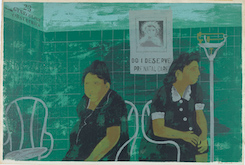
Great Depression Ben Shahn,Prenatal Clinic, 1941, screenprint, Reba and Dave Williams Drove, Gift of Reba and Dave Williams, 2008.115.4345
This prototype of two women in a dr.'s waiting room at a hospital or clinic was an unusual, and even taboo, choice of subject field. While today we are accepted to open discussions about pregnancy and associated health care, in the 1940s (and until the 1960s), such subjects were non publicly discussed. A poster backside the women asks, "Do I deserve prenatal care," suggesting that some might answer "no." The two women, who wear maid uniforms typical of the period, appear distracted and disconnected from one another. The ambient of the green, tiled room is grim and unwelcoming.
Ben Shahn is known as a social realist, or artist who depicts the conditions and struggles of working-class people. He also worked with Mexican artists Diego Rivera and Frida Kahlo, whose piece of work similarly focused on the lives of ordinary people and women's experiences. Shahn painted murals for the Federal Fine art Project and also served as a photographer for the Subcontract Security Administration, documenting the plight of agricultural workers. He was married to creative person Bernarda Bryson, whose work is also featured in this resources.

Great Low Marion Greenwood, Associated American Artists,Mexican Harvest, 1941, lithograph in blackness on wove paper, Reba and Dave Williams Collection, Souvenir of Reba and Dave Williams, 2008.115.2239
Marion Greenwood, born in Brooklyn to a family unit of artists, began her art studies early. By age xv she was enrolled at the Art Students League of New York. She established a successful portrait-painting exercise while all the same young, an endeavor that financed her subsequent travels around the Usa, Europe, and United mexican states. Greenwood first went to Mexico in 1932 and was deputed to create murals for the Mexican government, sometimes traveling with her sister Grace, besides an artist. She returned to the United States around 1936 and was commissioned to create murals for the Department of the Treasury's Section of Fine Arts and the Federal Art Project.
This paradigm reflects Greenwood's association and familiarity with Mexican themes. Mexican Harvest depicts indigenous women gathering wheat beneath a mountainous landscape. In the background, men as well dressed in traditional garb load wheat onto the backs of horses or donkeys. Men and women work side by side as equals, laboring to bring in the life-sustaining harvest.

Great Depression José Clemente Orozco, George C. Miller,Flag (Bandera), 1928, lithograph, Rosenwald Collection, 1944.ii.45
Mexican artists such as José Clemente Orozco, Diego Rivera, and David Alfaro Siqueiros played an important function in influencing the course of art in the United States during the Corking Depression. During the Mexican Revolution (1910–1920), these artists and others were commissioned by the regime to create images intended to stoke national pride in Mexican heritage and identity. The artists depicted the revolution'southward humble heroes: working-course people; campesinos, or farmers; and the lives of indigenous people, long treated every bit an underclass by the dominant culture. Here, campesinos in traditional clothes, armed with rifles slung over their shoulders, comport the new Mexican flag. A draped pregnant woman stands nearby, possibly symbolizing the birth of a new era for ordinary Mexicans.

Great Low Diego Rivera,Viva Zapata, 1932, lithograph in black on Rives BFK paper, Gift of Mrs. Robert A. Hauslohner, 1990.106.51
This image memorializes Emiliano Zapata (1879–1919), a folk hero of the Mexican Revolution (1910–1920). Diego Rivera rendered this image of Zapata iii times. The first was for a public mural he painted in Cuernavaca, deputed by the Mexican authorities in 1929. Its purpose was to instruct illiterate Mexicans about the history of the Mexican Revolution. In 1931, Rivera painted a copy for a portable fresco he made for a solo exhibition of his art held at the Museum of Modern Art in New York. Finally, Rivera created this lithograph version.
Zapata stands over the slain body of a hacienda owner, or oppressor. Campesinos, farmworkers, line up behind him with just their farming implements as weapons. The revolutionary Zapata was a charro, or cowboy, and is usually pictured in flamboyant apparel. Hither, even so, he is dressed as a peasant in solidarity with the farmers, for whom he seeks landownership reform. The Cuernavaca murals were Rivera'due south first landscape commissions from the Mexican government; they sought to illustrate the cultural history and new values of United mexican states through fine art. The Mexican programme provided a model for the U.s.a. in the 1930s, demonstrating how regime-commissioned art could foster a sense of national pride.
0 Response to "What Best Describes the Character of the Murals Painted Under the Federal Art Project?"
Post a Comment